Blog

Archive for Announcements – Page 4

How Property Managers Can Prepare for Sealcoating

Property managers understand the need to protect the owner’s assets, and they realize that asphalt sealcoating is an economical way to prolong the life of asphalt pavement. A periodic application of sealcoating can help prevent pavement damage caused by the sun, automotive fluids and vehicle traffic. Sealcoating also improves the property’s curb appeal by refreshing the color of asphalt pavement and concealing minor surface blemishes. However, if you want a sealcoating job that will flow smoothly and yield the best results, your involvement is vital in the days leading up to the work.

How Property Managers Can Prepare for Sealcoating

As soon as you realize that your asphalt pavement needs fresh sealcoating, the first thing you should do is conduct an inspection of your pavement. Potholes, cracks, soft spots and areas suffering from alligator cracking will need to be repaired prior to the sealcoating application. Most asphalt contractors who perform commercial sealcoating can handle the repairs. Choosing a  contractor who also offers asphalt repairs will usually result in monetary savings as well as expedite the completion of all tasks.

The next thing you should do is select a reliable asphalt paving contractor. You need a contractor with excellent communication skills. He should be able to explain every phase of your project in clear, concise terms. It should never be a major undertaking to contact the contractor or his representative before, during and after the job. When you check the contractor’s references, be sure to ask whether he communicated effectively with the client throughout the process.

What Are the Typical Responsibilities of Property Managers for Preparing for Sealcoating?

Although your sealcoating contractor will handle most of the preparation, there are a few details that you will need to manage. Alone or with help from the contractor, property managers typically handle the following responsibilities.

• Prepare and send a letter to your tenants at least a week before the work is scheduled to begin. Let them know which areas will be undergoing work on each day of the project, whether certain access points will need to be closed during the work and where the alternative parking areas are located. Advise tenants that they will need to make sure that their vehicles are removed from the work area no later than the night before the contractor is scheduled to start work.
• The same information will need to be communicated to your employees, but you may prefer to send an email or memo rather than a letter.
• If any areas are secured by locked gates, arrange for someone to be present to provide the contractor’s crew with access. Alternatively, you could give copies of the keys to the contractor a day or two before work is scheduled to commence.
• Storage pallets, disabled vehicles and other obstructions should be removed from the work area.
• Authorize one of your employees to make necessary decisions about the work if you are unavailable. Make sure that your contractor has this person’s contact information.
• Maintain communications with the contractor so that you will have advance knowledge of any scheduling changes. Be sure to pass any new information on to your tenants and employees.

A successful, quality sealcoating job is far easier to obtain if the proper preparations are made and the lines of communication remain open. By working closely with your contractor, you can help ensure that you will receive a beautiful, durable sealcoating job.

If you need a reputable paving contractor who understands the needs of property managers, contact All Pro Asphalt. We serve clients throughout the Kansas City area with exceptional sealcoating, asphalt repair, commercial paving, parking lot striping and concrete services. We are known for delivering outstanding work and superior customer service. If you would like to request a free quote, call (816) 249-6800 or submit our online form.

Recent BLOGs

Asphalt Sealcoating: Adding an Aggregate

Service Areas

What Are the Cost Factors for Asphalt Sealcoating?

When it comes to asphalt maintenance procedures, a professional sealcoating job can more than pay for itself. Sealcoating is a surprisingly affordable way to help avoid costly repairs, maximize the life of the pavement and enhance the aesthetic appeal of your property. Paving companies frequently receive calls from customers who want to know how much it will cost to apply sealcoating to their pavement, believing that the only information the contractor needs is the total square footage of the area to be sealed. Although it is not difficult to provide a price for the sealant, that is basically just the starting point; there are other cost factors that must be included to arrive at the total price for the job.

What Are the Cost Factors for Asphalt Sealcoating?  How Do Asphalt Contractors Calculate the Price of a Sealcoating Job?

There are numerous types of sealants on the market that are of different quality levels and are meant for different uses. Sealcoating contractors know how much it will cost to apply a square foot of each type of sealant. However, they must first determine which type is suitable for your pavement. The sealant must be suitable for the volume of traffic and the weight of the vehicles that will be using the pavement. Furthermore, multiple coats of sealant may be needed, especially in areas of concentrated traffic flow, including exits and drop-off lanes. Asphalt contractors must include the type of sealant and the number of coats when determining how much to charge for a sealcoating job.

When preparing a quote, paving companies must also ascertain the current condition of the pavement. Cracks and potholes will need to be repaired prior to sealcoating, so this expense will need to be included in the quote. Heavily oxidized pavement may require a primer, and this will also increase the cost of the job.

The layout of the site can be an important consideration as well. A flat, open expanse can be sealed with less difficulty than a site that will require numerous cut-ins or one that has multiple twists and turns. As a rule, the more handwork required for the job, the more it will cost; handwork increases the hours needed to complete the job.

Another important consideration is how many times the contractor must move his equipment and crew to the site. For example, it may be necessary to divide a massive parking lot into zones that can be completed and reopened before closing another area. This will typically require the contractor to transport his crew and equipment daily until work has been completed on the entire lot. Each mobilization can increase the cost of the job.

Sealcoating contractors must have all of the above information before they can determine what their labor, material and transportation expenses will be, and only then can they calculate what they must charge for the job. Therefore, when you start calling asphalt contractors for pricing information, keep in mind that you will only receive a very rough estimate until the contractor has assessed all potential cost factors.

For Asphalt Services You Can Trust

All Pro Asphalt provides a range of asphalt maintenance and asphalt paving services to clients throughout the Kansas City area. Our services include asphalt sealcoating, asphalt repairs, concrete repairs, parking lot striping, asphalt paving and overlays, concrete installation and infrared asphalt restoration. Our commitment to excellence and customer satisfaction, our extraordinary workmanship, our competitive rates and our use of high-quality products have helped us establish ourselves as one of the region’s best-regarded paving companies. To request a free quote, you can either submit the online form or call (816) 249-6800.

Do You Trust Your Asphalt Contractor?

See Our Service Areas

Asphalt Sealcoating: Adding an Aggregate

Like any object that is exposed to the ravages of weather, asphalt pavement can become faded, dry or brittle. However, your pavement must also bear the weight of traffic. The heavier or more numerous the vehicles are that are using your pavement, the more likely it is that your pavement can be damaged. Sealcoating is a highly effective, economical way to protect your pavement from both the weather and the traffic it must bear. However, for sealcoating to be effective and long-lasting, the sealant mix must be prepared properly. A good mix will include an aggregate.
Asphalt Sealcoating: Adding an Aggregate

In general, aggregates are particulates that are added to a liquid or slurry. One example of a commonly seen aggregate would be the gravel or small rocks incorporated into a concrete mix. For sealcoating mixes, the aggregate of choice is silica sand.

• Silica sand is essentially quartz that has been pulverized by wave action occurring along coastlines.
• It is extremely pure, requiring little additional cleaning before it can be used in sealcoating.
• The tiny grains tend to be of a uniform size, eliminating the need to process the sand through a crusher.
• Silica sand is plentiful and concentrated in areas where it is easy to collect, so it is an economical aggregate for sealcoating mixes.

Why Do Sealant Mixes Need an Aggregate?

Adding an aggregate to a sealcoating mix offers several immediate and long-term benefits.

• Aggregates improve surface traction. Without an aggregate, the sealed surface can be slippery, especially during or immediately after it rains. Sand added to a sealant mix helps prevent tire slippage, but it also improves traction for pedestrians.
• Aggregates improve the sealant’s durability. An aggregate helps the sealant establish a stronger bond with the pavement, so the sealcoating is less likely to be dislodged by vehicles that are braking or turning. A sealant containing an aggregate is also tougher, so it will last longer under normal conditions than a sealant without an aggregate.
• The surface will be more visually appealing. The sand in the sealcoating mix will settle into any hairline cracks or minor voids, giving the surface a smoother, cleaner appearance.
• Aggregates help control the drying of the sealant. There will be less water in the mix, so evaporation will not take as long. However, aggregates also help prevent the water from evaporating too quickly; this can lead to cracks on the surface of the sealant.

Why Do Some Contractors Omit an Aggregate?

The decision to leave out an aggregate is typically based on the contractor’s finances. A quality machine that can keep the mix agitated and the aggregate distributed evenly costs in the neighborhood of $25,000. Furthermore, although silica sand is economical, it is not free, so paying for the aggregate reduces the contractor’s profit. In addition, without an aggregate, the contractor can add more water, so a gallon of the mix can be sprayed on a larger area.

A credible asphalt company who wants your continued business will always add an aggregate. The people who do not incorporate an aggregate tend to be gypsy contractors who are constantly moving from town to town; they can afford neither the cost nor the encumbrance of quality equipment. They often prepare their mixes in a large barrel or recycled drum. However, since there is no agitator or pump, it is immaterial whether an aggregate is used — it would quickly fall out of suspension and do little more than coat the bottom of the container.

Hire a True Sealcoating Professional

All Pro Asphalt is a highly respected asphalt maintenance company serving commercial and residential customers throughout the greater Kansas City area. We take pride in delivering quality work that goes beyond the customer’s expectations. In addition to asphalt sealcoating, we also offer parking lot striping, asphalt crack sealing, asphalt paving, infrared asphalt restoration, asphalt repair and concrete work. You can call (816) 249-6800 or submit our online form to request a free quote.

Recent FAQs

Parking Lot Striping: What You Need To Know

Service Areas

Do You Trust Your Asphalt Contractor?

Contractors in some trades have a difficult time concealing shoddy work. For example, it is fairly easy to tell if the siding panels or asphalt shingles you had installed are misaligned. If you ask a flooring contractor to install blue sculptured carpeting, you will immediately notice if he installs green shag. You will also be able to tell if a landscaping contractor plants a tree in the wrong location. However, when you are having asphalt pavement built or repaired, it can be months or even years before you can be certain that you received quality workmanship. The simple truth is that what may appear to be perfectly fine could turn out to be a costly disaster if you choose the wrong contractor. The following pointers can help you ensure that you have found an asphalt contractor you can trust.

Do You Trust Your Asphalt Contractor?  How Does the Contractor Treat You?

A trustworthy paving company will treat you, your employees and your property with respect. When you make an appointment, the contractor will arrive on time, indicating his respect for your schedule. He will not evade your questions, refuse to look you in the eye or shrug off your concerns. He is willing to answer your questions or explain every step of the project without becoming annoyed, impatient or evasive.

What Do Others Think About the Contractor?

Experienced asphalt contractors will be able to supply you with recent, relevant references. He will provide you with the address of the work as well as the information you need to contact the client. If you can, take a drive to view several of his completed projects; at the very least, call the references he provided. Ask them whether the work was completed by the promised date and at the quoted price. Ask whether they are happy with the quality of the work. In addition, ask them whether they would hire the same contractor for their next asphalt project.

Does the Contractor Provide You With Vital Information?

Before you commit to a specific contractor, make sure that he provides you with certain information that can help you determine his credibility.

• Are the workers the company’s employees or temporary laborers? Employees are typically better trained and more experienced. Make sure that every employee working on your site is covered by the contractor’s workers’ compensation policy.
• Ask the contractor how long the company has been in business under its current name. Ask whether the company has operated under other names. Check all company names with the Better Business Bureau.
• Ask the contractor for proof of his liability and vehicle insurance coverage. If he carries an umbrella policy as well, ask about coverage limits.
• Qualified asphalt paving contractors guarantee their work. Manufacturers may have warranties on their products, but if the contractor does not follow their specifications, these warranties could be declared void. A contractor’s warranty does not cover defective materials, but it can help protect you from costs resulting from inferior workmanship.
• How detailed is the contract presented to you for signature? Ideally, the contract should specify the schedule, the job scope, the types and quantities of materials, the thickness of the pavement and the amount allocated to labor. It should also state who will be responsible for securing any applicable permits or paying any disposal fees.

If you need a trustworthy, experienced asphalt contractor, contact All Pro Asphalt. We serve customers throughout the greater Kansas City area with quality work, including asphalt paving, infrared asphalt repair, parking lot striping, sealcoating, asphalt crack repair and concrete installation. We are known for our workmanship, customer service and affordable rates. To request a free estimate, submit the online form or call (816) 249-6800.


Recent BLOGs

Sealcoating – Why May Is Ideal for Sealcoating

See Our Service Areas

Parking Lot Striping: What You Need To Know

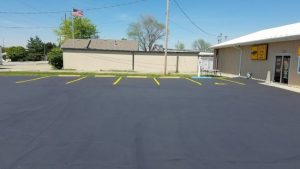
When done correctly, fresh paint can make your property more attractive to potential customers, tenants and employees. A well-striped, properly marked parking lot conveys the impression that you pay attention to details, have pride in your business and care about the convenience and safety of those who access your property. Conversely, a parking lot with faded or missing markings may leave visitors wondering whether the interior of your property is also poorly maintained. Although pavement striping and markings may seem simple, there are many details that can affect the quality of the job.

Parking Lot Striping: What You Need To Know

As with many tasks, asphalt striping and marking a parking lot requires planning, preparation and effort to achieve the best results. Here are a few things that you should know for your paving contractor about getting the most for your money.

• With very few exceptions, parking lots are required to comply with the Americans with Disabilities Act. Some local governments have enacted accessibility codes that are even stricter than the federal ones. Under federal law, you must make sure that your parking lot is compliant when you have new markings applied. If you have not had fresh paint applied for several years, your lot may not be in compliance unless its design is altered.
• Virtually every decision can affect the number of parking stalls that will fit in a given space. For example, travel aisles must be wider if they are used for two-way traffic instead of one-way traffic. Head-in parking stalls allow more spaces, but they also require a larger allotment of space for turning.
• Your parking lot should remain closed to vehicles for at least 30 minutes after the paint seems to have dried. Ask your contractor how long to keep the area closed to foot traffic and vehicle traffic; you may be able to allow foot traffic sooner than you can allow vehicle traffic.
• Some pavements will absorb more paint than others, reducing the visibility of the markings and stripes. However, if this happens, ensure that your contractor does not try to compensate by applying a thick coat of paint rather than two or more thin coats.
• The average parking lot will require fresh paint every 18 to 24 months. However, high-volume lots may need annual striping. As a rule, once the visibility of the paint drops below 75 percent of its original clarity, the parking lot should be repainted.
• The type of paint must be matched to the type and condition of the pavement. For example, rubber-based paints are typically best for concrete, but water-based paints are usually preferred for new asphalt pavements.
• Having asphalt sealcoating applied prior to striping makes your parking lot even more attractive. Furthermore, sealcoating helps you extend the life of your pavement.
• You might want to consider the importance of curb paint. Marking loading zones, fire lanes, no-parking zones or disabled access can help eliminate confusion and make the parking lot safer.

If you need parking lot striping and pavement markings, you can trust All Pro Asphalt to deliver exceptional work at affordable rates. In addition, we offer asphalt and pavingsealcoating, asphalt repair, infrared asphalt restoration, concrete work, asphalt crack repair, car stops, speed bumps, parking lot signs and reflectors. For a free quote, fill out the online form or call 816-249-6800.

Recent BLOGs

Asphalt Sealcoating & Windy Conditions

Service Areas

Sealcoating – Why May Is Ideal for Sealcoating

Having sealant applied every few years is an extremely effective and economical way to ensure that you obtain the longest life possible for your asphalt pavement. Asphalt sealcoating blocks the harsh rays of the sun that can dry out asphalt pavement and fade its color. Sealants also help protect against the penetration of oil and other petroleum-based fluids that can soften the pavement. In addition, sealcoating will restore the lustrous color that your pavement displayed when it was new. However, many people who realize the benefits offered by sealcoating can be uncertain of the best time of year to have new sealant applied. If you are wondering when you should schedule your sealcoating job, May is the best month.

Sealcoating – Why May Is Ideal for Sealcoating

To understand why May is the best month for sealcoating, it may help to discuss the sealants themselves. The protection provided by sealcoating relies on a strong bond between the sealant and the pavement as well as the sealant’s ability to cure properly so that a hard shell forms on the surface. Sealants can be quite demanding when it comes to the wind speed, the humidity and the temperatures of the ground and air. All of these factors interact to affect the curing process.

On extremely hot days, the sealant may dry too quickly on the surface, slowing the drying of the lower layers. High winds can cause the same problem. If you combine high temperatures with strong winds, the problem is magnified.

However, if the temperature is too cool, the sealant will not dry as quickly as it should. High humidity levels and/or very light winds will also delay drying.

In the Kansas City area, May is the month in which all factors are the most favorable for sealcoating. In April, overnight temperatures often fall below the threshold for sealcoating. By June, the daytime highs can exceed the recommended maximum temperature for applying a sealant. In August and September, the humidity levels are typically higher than in May. By October, the risk of temperatures falling too low overnight increases. Furthermore, in the summer, grass clippings can be blown onto the wet sealant; in the autumn, fallen leaves may be blown onto the freshly sealed pavement.

Sunlight also plays a role in the curing of sealcoating. Ideally, sealants should be exposed to several hours of direct sunlight immediately after application. May offers extended hours of sunshine that are missing in April and October.

A final reason for scheduling your sealcoating in May has to do with the contractor’s schedule. Many schools and other companies that experience a low volume of traffic during the summer months postpone work until after May. Other customers want to delay work until the fall so that they can feel secure that their pavements will be properly prepared for winter’s onslaught. Therefore, you will probably have a better chance of finding a contractor who can perform your sealcoating on the date of your choosing.

Call All Pro Today

All Pro Asphalt is an asphalt contractor and offers sealcoating, asphalt stripingasphalt crack sealing, infrared asphalt restoration, asphalt repair, asphalt paving, concrete repair and asphalt maintenance to customers throughout the greater Kansas City area. We are known for our outstanding workmanship and commitment to customer satisfaction. You can call (816) 249-6800 to request a free estimate or use the online form to send us the details about your project.

Recent FAQs

Sealcoating: Successes & Failures

See Our Service Areas

Asphalt Sealcoating & Windy Conditions

Customers sometimes wonder why credible asphalt sealcoating professionals refuse to apply sealants on certain days. To the customer, the conditions may seem acceptable. However, the contractor knows that sealcoating is extremely sensitive to environmental factors, so what may seem like acceptable conditions to others may actually be totally unsuitable. Humidity, temperature and sunlight are all important for the effective curing of sealant, but the wind is a fourth factor that is not as well understood by many customers.

Asphalt Sealcoating & Windy Conditions – How Wind Affects Curing

When sealants are applied, the water that they contain must evaporate if the sealant is to cure thoroughly. On a windless day, the water that is initially evaporated will hover close to the surface, stalling the evaporative process. The colder it is and the higher the humidity level, the more critical it is to have a little wind to circulate the air.

However, high winds can also negatively affect the curing process. If the wind is too strong, the sealant’s surface layer will evaporate its water too quickly. When the rest of the sealant evaporates its water, the top layer can crack and flake. This is unsightly, but it can also result in an insufficient amount of sealant in the damaged areas.

Asphalt Sealcoating & Windy Conditions – How Strong Winds Affect Sealcoating Application

Sealcoating professionals know that the best results are achieved by applying an even layer of sealant. If the pavement is a parking lot or other large area, sealants are typically applied with a sprayer. The rate of spray and the spray pattern are carefully calculated, but if the wind is strong, the sealant can be blown away as it leaves the sprayer. This can lead to areas that receive an insufficient amount of sealant as well as areas that receive too much sealant. The effectiveness of the sealant and the appearance of the pavement can be negatively impacted.

Because the wind scatters the sealant, the risk of overspray increases with the wind speed. Droplets of sealant can be blown onto nearby vehicles, buildings, fences, sidewalks, landscaping, walls, signs and painted curbs. Cured sealcoating can be difficult to remove from unwanted areas without causing damage. To reduce the chances of overspray, sealcoating contractors will typically apply the sealant by hand around the edges of the pavement. The higher the wind speed, the wider the manually applied perimeter will need to be. This can affect the appearance and performance of the sealcoating in these areas.

Another challenge when applying sealcoating on a windy day involves what the wind may carry onto the wet sealant. In the spring, many trees distribute their seed pods, and in the summer, grass clippings can be blown onto the wet pavement. In the autumn, dead leaves are often a problem when sealcoating on a windy day. Candy wrappers, dirt and other debris can be carried by the wind during any season. Removing foreign material from wet sealcoating is typically impossible to do without compromising the quality and appearance of the work.

Credible Sealcoating Professionals Know When to Postpone Applications

Credible sealcoating professionals who are committed to delivering quality work and building lasting relationships with their customers know that there are times when it is best to delay an application. All Pro Asphalt is an asphalt maintenance service contractor and we are dedicated to delivering exceptional results and ensuring that every customer is completely satisfied with our work, so we make sure that conditions will allow us to meet both goals. We offer an extensive range of asphalt pavement services, including seal coating, parking lot striping, asphalt repair, asphalt paving, infrared asphalt restoration, concrete installation and concrete repair. If you have more questions about Asphalt Sealcoating & Windy Conditions or would like a free estimate, call (816) 249-6800 or completing the online request form.

Recent BLOGs

https://allproasphaltkc.com/traffic-signs-pavement-marking/

See Our Service Areas Below-

Sealcoating: Successes & Failures

April 17th, 2018 | Posted in Asphalt Sealcoating | No Comments

Studies have shown that if the sealcoating is maintained throughout the life of an asphalt pavement, the pavement can last up to twice as long. Sealcoating is an economical, extremely effective way to help protect asphalt pavement from the damaging effects of the sun, petroleum-based automotive fluids, harsh chemicals and water penetration. To obtain the best results for the pavement, however, it is necessary to obtain the best results from a sealcoating application. If the sealcoating fails, the pavement will not have the protection it needs to achieve its full life. You could be faced with having to pay to have fresh sealcoating applied much sooner than you expected.

Sealcoating: Successes & Failures – Why Sealcoating Can Deteriorate Prematurely

Sealants are in a liquid state when they are applied. As the sealcoating dries and cures, it forms a hard shell and forms a strong bond with the pavement. Anything that interferes with the formation of the bond or the shell can cause the sealcoating to fail.

• Oil Stains: The ability to prevent two substances from sticking to each other is often desirable, but oil spots on asphalt pavement can lead to a sealcoating failure. The sealant will not be able to bond to the oily area. Prior to applying a sealant, oil spots must be thoroughly cleaned. In many instances, however, cleaning is not enough, so a primer may need to be applied to ensure a strong bond.
• Foreign Materials: Dirt, grass clippings and gravel will interfere with the establishment of a strong bond. All such materials must be removed and the pavement cleaned properly before the sealcoating application begins.
• Unrepaired Damage: Sealants are not repair products. They cannot repair alligatored asphalt, fill potholes or seal large cracks. Damaged areas must be repaired before the sealant is applied to ensure a proper bond is established and to prevent flaking and cracking of the sealcoating.
• Pavement’s Age: New asphalt pavement should not be sealed before the excess oil in the pavement has had time to dissipate. Depending on the weather, the pavement may need to age for as long as 12 months, but in most cases, sealcoating can be applied in as little as 60 days following the installation.
• Skipping Primer: Oil spots are not the only areas that may need to have primer applied. Older pavements often have stones or rocks that have become polished and too smooth for a bond to form without primer. A highly oxidized pavement may also need to be primed prior to sealcoating.
• Tree Sap: Special attention must be given to areas with tree limbs that hang over the pavement. If sealant is applied over sap, the sap will prevent bonding, causing the sealant to develop localized flaking. The sap must be removed before applying the sealant, and in many cases, this will require power washing or intensive scrubbing.

If you want to avoid the premature failure of your asphalt sealcoating, you should select a reputable, experienced contractor. At All Pro Asphalt, we are sealcoating experts serving the greater Kansas City area. We also offer parking lot striping, infrared asphalt repair, asphalt paving, concrete work and asphalt crack repair. We use only the best products and techniques to ensure that you will be completely satisfied with the results. If you have more questions about Sealcoating: Successes & Failures, or would like to request a free, no-obligation estimate, please submit our online quote request or call 816-249-6800.

All Pro Asphalt – Ranking as one of the top sealcoating contractors in Kansas City!

Recent BLOGs

Asphalt Crack Repair – Hot & Cold Sealants


See Our Service Areas Below-

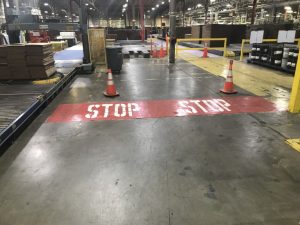
Why Traffic Signs & Pavement Marking Is Important

Imagine that you need to drive to another town by one of two highways. The first highway has freshly painted centerlines, warning signs before every sharp curve, lane markings, edge lines, speed limit signs and warning signs for every merge, shoulder drop-off, intersection, dip and lane transition, but the second highway has none of these traffic signs, parking lot striping, and pavement markings. Which highway would you prefer to drive in the dark?

Why Traffic Signs & Pavement Marking Is Important

Now imagine that you can choose between two grocery stores that offer identical prices. The parking lot at the first store has vibrant stripes to mark every parking space, pavement markings to show the direction of travel, a highly visible crosswalk, stop signs where the driveway meets the street, clearly marked no-parking zones, handicapped parking spaces that are easy to identify and pavement markings before every speed bump. The parking lot at the second store is basically a plain stretch of pavement. Parking spaces are not striped, so there are cars angled to the left as well as to the right; some cars are parked at an angle of 90 degrees, and some cars are parked perpendicular to the store. Traffic aisles are impossible to determine. There are no signs or markings denoting accessible parking spaces — in fact, there are no signs or markings whatsoever. In which lot would you feel better about parking your new car?

Now imagine that you own the second grocery store. For years, your customers have complained to you about the appalling state of your parking lot. Several people have reported minor damage to their vehicles or close calls in your lot. Eventually, two expensive cars collide or a pedestrian is struck by an SUV and seriously injured. Do you have a good lawyer to defend you in the lawsuit that could follow?

Why Pavement Markings and Traffic Signs Were Invented

The scenarios discussed give you a look at how driving without signs or markings would be. What you may not know is that none of them existed when the automobile was first introduced in America. It took decades for traffic signs and pavement markings to be used, and the progress came at the expense of tens of thousands of lives, hundreds of thousands of injuries and millions of dollars in property damage. This is particularly appalling when you consider that the 1920 Ford Model T had a top speed of 35 mph — and that there were only 7.5 million vehicles of all types in the country. For comparison, there were almost 269 million vehicles registered in the United States in 2016.

History has proven that traffic signs and pavement markings make things safer for drivers, children, pedestrians and cyclists. Whether you are responsible for a parking lot, a state highway or a city street, you should make sure that your signs and markings are adequate.

All Pro Asphalt is an asphalt contractor in the Kansas City area and provides parking lot striping and installs parking lot signs, car stops, speed bumps and reflectors to help you ensure that your parking lot complies with the ADA and all local and state regulations. We also offer asphalt repair and infrared asphalt restoration, crack repair, sealcoating and concrete work. We are committed to delivering exceptional work at competitive rates. If you would like a free estimate, call 816-249-6800 or complete the online form.

Service Areas

Recent FAQs

https://allproasphaltkc.com/have-you-seen-your-asphalt-paving-lot/

Asphalt Crack Repair – Hot & Cold Sealants

Your asphalt pavement faces many challenges over the years. The UV rays emitted by the sun can make the asphalt dry and brittle. The freeze/thaw cycle can break down the binder, making the paving less flexible. Overweight vehicles can damage the pavement. Cars and trucks can leave puddles of oil that can soften the pavement. Any of these issues can lead to cracks in your pavement, and if these cracks are neglected, the life of your asphalt pavement can be shortened significantly. Asphalt crack repairs are necessary to prevent water penetration that can destabilize the supporting base layers. A destabilized base often results in alligator cracking and/or numerous potholes. However, even people who understand the importance of having cracks repaired quickly are sometimes not sure whether to choose hot-pour or cold-pour sealants for the repairs. Both types of sealants have their uses, but there are several important differences between cold-pour and hot-pour crack sealants.

Asphalt Crack Repair – Hot & Cold Sealants

What Are Cold-Pour Sealants?

Cold-pour sealants arrive at the job site as liquids that can be poured immediately and do not need to be heated before they are applied. They are faster to apply and require less equipment than hot-pour sealants. This makes them less expensive for a short-term solution, but because they do not last as long as hot-pour sealants, they can be substantially more expensive over time.

Cold-pour sealants are incapable of forming a strong, durable bond to the pavement surrounding the crack. They also become inflexible and hard after curing. As a result, cold-pour sealant is easily ejected when freezing temperatures arrive. Even normal traffic can sometimes break the bond and dislodge the material.

Cold-pour sealants are unsuitable for deep or wide cracks. Therefore, they are normally reserved for repairing small cracks in residential driveways that bear only lightweight traffic.

Because cold-pour sealants contain a high proportion of water, the weather conditions must be considered when using these sealants. The water must evaporate if the sealant is to cure. Evaporation occurs much slower in cold weather or when humidity levels are high.

What Are Hot-Pour Sealants?

Hot-pour sealants are asphalt-based products that arrive at the job site as solids. They must be melted before they are poured.

Hot-pour sealants remain flexible after curing, so they can expand and contract when the surrounding pavement thaws and freezes. They also form a very stable bond with the surrounding asphalt. Therefore, hot-pour sealants are much less likely to experience a bonding failure or be dislodged by traffic.

Hot-pour sealants can be applied in cold weather, and because they contain little water, the evaporation rate is of little or no consequence. Furthermore, the lower water content makes hot-pour sealants far less likely to shrink during curing than cold-pour varieties.

Hot-pour sealants offer a semipermanent solution. While cracks repaired with a hot-pour sealant may not last for the remainder of the pavement’s life, they will last much longer than those repaired with a cold-pour sealant. The life of a cold-pour crack repair can be as little as a few months, but a hot-pour crack repair can last several years.

For Expert Help, Contact All Pro Asphalt

All Pro Asphalt is a parking lot maintence contractor that serves the Kansas City area.  We specialize in providing efficient, cost-effective asphalt maintenance and repair to residential and commercial customers throughout the greater Kansas City area. Our services include asphalt crack sealing, parking lot striping, infrared asphalt repairasphalt sealcoating and asphalt paving. We also install, repair and maintain concrete. We are committed to providing superior results and outstanding service at highly competitive rates. If you have more questions about Asphalt Crack Repair – Hot & Cold Sealants or would like to receive a free quote, you can call (816) 249-6800 or submit the online form.

Service Areas

Recent FAQs

https://allproasphaltkc.com/choosing-the-right-asphalt-paving-contractor/

"*" indicates required fields

This field is for validation purposes and should be left unchanged.
REQUEST AN ESTIMATE
Request Estimate